
MRI
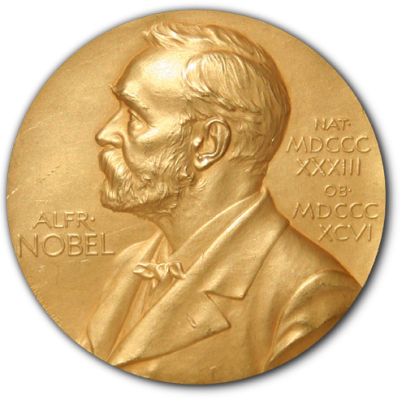
Magnetic resonance imaging is based on the principle of Nuclear Magnetic Resonance, a chemical imaging technique, which gained the Nobel Prize for physics in 1952, allowing easier analysis of chemical structures.
Atomic nuclei in a strong magnetic field rotate with a frequency which depends on that of the field. The energy of this rotation can be increased if they absorb radio-waves at the same frequency. When the nuclei return to their previous energy state radio-waves are emitted. NMR detects the small differences in resonance emitted by hydrogen atoms in different structures. Since the body is mostly water, and all tissues have different water content, analysing the differences in hydrogen molecules across a cross-section of the body gives a detailed analysis of the tissue.
Many researchers sought to apply NMR to physiology. US Chemist Paul Lauterbur was present during early analysis of dissected rat tissue by NMR, and felt that it should be possible to study a whole, intact animal in a non-invasive way. Early in the 1970s he found that a two-dimensional image could be generated by graduating the magnetic field and analysing the radio-waves which were emitted to determine their origin.
Physicist Peter Mansfield developed a mathematical analysis of the resonance signals across the gradients. This gave a powerful imaging technique, allowing two dimensional cross-sections of objects to be viewed. He also showed how fast analysis of the signals could be achieved, a technique which medical technology made possible a decade later in the 1980s, making it possible to ‘see inside’ a living organism using MRI.
Tags
Research Fields: Biochemistry, Medical technologies(yes - 2 items)Date: 2003 (required)
Scientist(s): Peter Mansfield, Paul Lauterbur (required)
Countries: United States of America, United Kingdom(yes - 2 items)
Animals Used: Rat(required - 1 items)
Description: The 2003 Nobel Prize for physiology or medicine was awarded to Paul Lauterbur and Peter Mansfield for developing Magnetic Resonance Imaging technology. (yes)
Medical Applications: Medicine, Basic research(yes - 2 items)